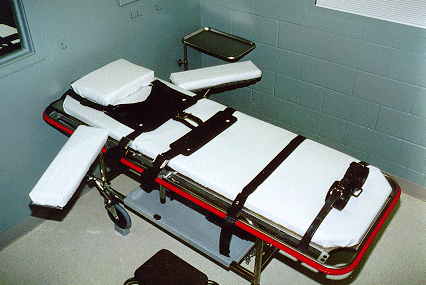
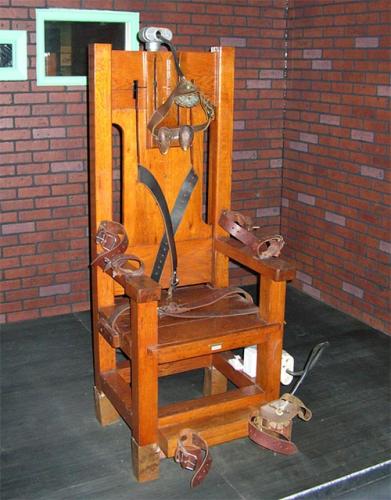
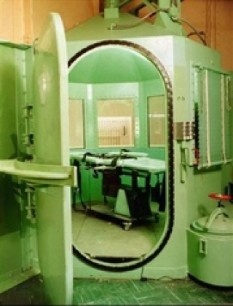
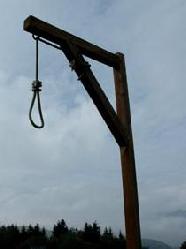
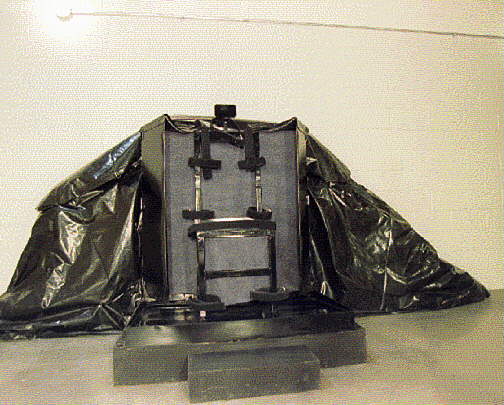
Lethal Injection When this method is used, the condemned person is usually bound to a gurney and a member of the execution team positions several heart monitors on this skin. Two needles (one is a back-up) are then inserted into usable veins. Long tubes connect the needle through a hole in a cement block wall to several intravenous drips. The first is a harmless saline solution that is started immediately. Then, at the warden's signal, a curtain is raised exposing the inmate to the witnesses in an adjoining room. Then, the inmate is injected with sodium thiopental - an anesthetic, which puts the inmate to sleep. Electrocution For execution by the electric chair, the person is usually shaved and strapped to a chair with belts that cross their chest, groin, legs, and arms. A metal skullcap-shaped electrode is attached to the scalp and forehead over a sponge moistened with saline. An additional electrode is moistened with conductive jelly (Electro-Creme) and attached to a portion of the prisoner's leg that has been shaved to reduce resistance to electricity. The prisoner is then blindfolded. After the execution team has withdrawn to the observation room, the warden signals the executioner, who pulls a handle to connect the power supply. A jolt of between 500 and 2000 volts is released, which lasts for about 30 seconds. The current surges and is then turned off, at which time the body is seen to relax. Then doctors wait a few seconds for the body to cool down and then check to see if the inmate's heart is still beating. If it is, another jolt is applied. This process continues until the prisoner is dead. Lethal Gas/Gas Chamber For execution by this method, the condemned person is strapped to a chair in an airtight chamber. Below the chair rests a pail of sulfuric acid. A long stethoscope is typically affixed to the inmate so that a doctor outside the chamber can pronounce death. Once everyone has left the chamber, the room is sealed. The warden then gives a signal to the executioner who flicks a lever that releases crystals of sodium cyanide into the pail. This causes a chemical reaction that releases hydrogen cyanide gas. The prisoner is instructed to breathe deeply to speed up the process. Most prisoners, however, try to hold their breath, and some struggle. The inmate does not lose consciousness immediately. The inmate dies from hypoxia which the cutting-off of oxygen to the brain. Hanging For execution by this method, the inmate is weighed the day before the execution, and a rehearsal is done using a sandbag of the same weight as the prisoner. The rope is usually about 3/4-inch to 1 1/4-inch in diameter. This rope must be boiled and stretched to eliminate spring or coiling. The knot should be lubricated with wax or soap "to ensure a smooth sliding action," according to the 1969 U.S. Army manual. (The Corrections Professional, 1996 and Hillman, 1992). Immediately before the execution, the prisoner's hands and legs are secured, he or she is blindfolded, and the noose is placed around the neck, with the knot behind the left ear. The execution takes place when a trap-door is opened and the prisoner falls through. The prisoner's weight should cause a rapid fracture-dislocation of the neck. However, death does not usually occur immediately. The inmate usually suffocates to death. Firing Squad For execution by this method, the inmate is typically bound to a chair with leather straps across their waist and head, in front of an oval-shaped canvas wall. The chair is surrounded by sandbags to absorb the inmate's blood. A black hood is pulled over the inmate's head. A doctor locates the inmate's heart with a stethoscope and pins a circular white cloth target over it. Standing in an enclosure 20 feet away, five shooters are armed with .30 caliber rifles loaded with single rounds. |
     |
